Welcome to PyTorch-BSF!
Fit smooth, high-dimensional manifolds to your data — from a single GPU to a multi-node cluster.
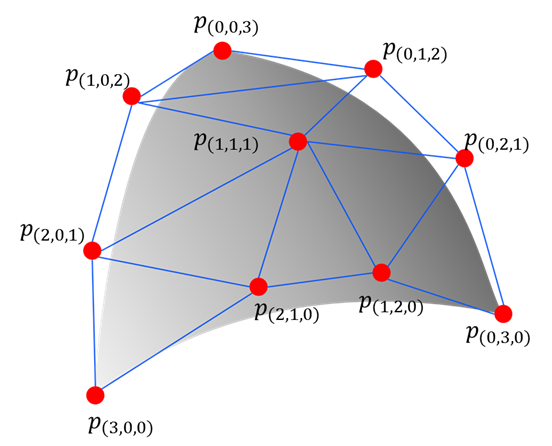
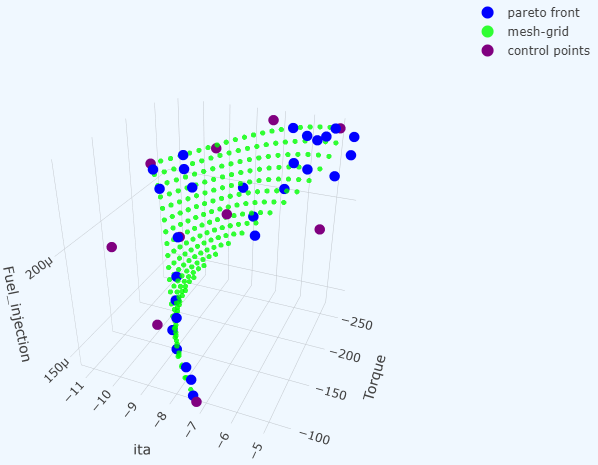
PyTorch-BSF brings Bézier simplex fitting to PyTorch. A Bézier simplex is a high-dimensional generalization of the Bézier curve: it can model an arbitrarily complex point cloud as a smooth parametric hyper-surface in any number of dimensions. This makes it a natural tool for representing Pareto fronts in multi-objective optimization, interpolating scattered observations, and fitting geometric structures in high-dimensional spaces.
The project is on GitHub.
User guide
- Quickstart
- Advanced Topics
- What is Bézier simplex fitting?
- Applications
- Elastic net model selection
- Robust portfolio management
- Distributed smart grids and energy operations
- Multi-task and federated learning
- Multi-objective model predictive control
- Communication systems and routing
- Supply chain and logistics optimization
- Medical imaging and radiation therapy
- Facility location and continuous approximations
- Frequently asked questions
- There are already many tools for hyperparameter search in ML. Why propose yet another one?
- Are approximation results always reliable?
- Are there any applications other than multiobjective optimization?
- How do I choose the degree of the Bézier simplex?
- How many training samples do I need?
- What if my input parameters do not lie on a simplex?
- Can I train on a GPU?
- What should I do if fitting does not converge or the accuracy is poor?
- When should I use partial training (the
fixargument)? - Can I verify whether my problem is weakly simplicial before fitting?
- What kinds of shapes can a Bézier simplex represent beyond Pareto fronts?
API reference