What is Bézier simplex fitting?
You are probably familiar with Bézier curves (1-D) and Bézier triangles (2-D) from computer graphics and CAD software. A Bézier simplex is their natural generalization to any number of dimensions: the same elegant polynomial construction, extended to an \((M-1)\)-dimensional surface defined over a standard simplex.
Just as a Bézier curve smoothly interpolates or approximates a 1-D point cloud using a small set of control points, a Bézier simplex can approximate a high-dimensional point cloud with excellent flexibility and mathematical guarantees.
This page introduces the formal definition of Bézier simplices, the least-squares fitting algorithm used by PyTorch-BSF, and motivating real-world applications.
Bezier simplex
Let \(D, M, N\) be nonnegative integers, \(\mathbb N\) the set of nonnegative integers (including zero!), and \(\mathbb R^N\) the \(N\)-dimensional Euclidean space. We define the index set by
and the simplex by
An \((M-1)\)-dimensional Bezier simplex of degree \(D\) in \(\mathbb R^N\) is a polynomial map \(\mathbf b: \Delta^{M-1}\to\mathbb R^N\) defined by
where \(\mathbf t^{\mathbf d} = t_1^{d_1} t_2^{d_2}\cdots t_M^{d_M}\), \(\binom{D}{\mathbf d}=D! / (d_1!d_2!\cdots d_M!)\), and \(\mathbf p_{\mathbf d}\in\mathbb R^N\ (\mathbf d\in\mathbb N_D^M)\) are parameters called the control points.
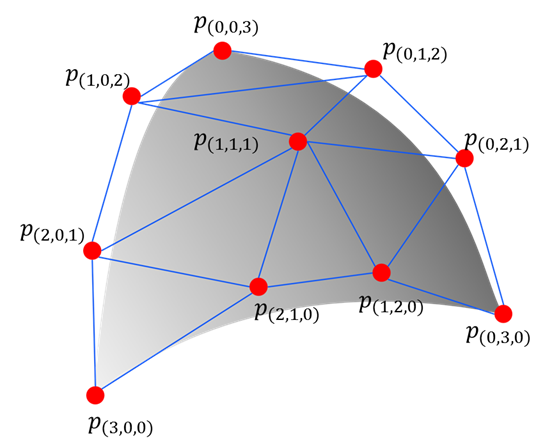
Fitting a Bezier simplex to a dataset
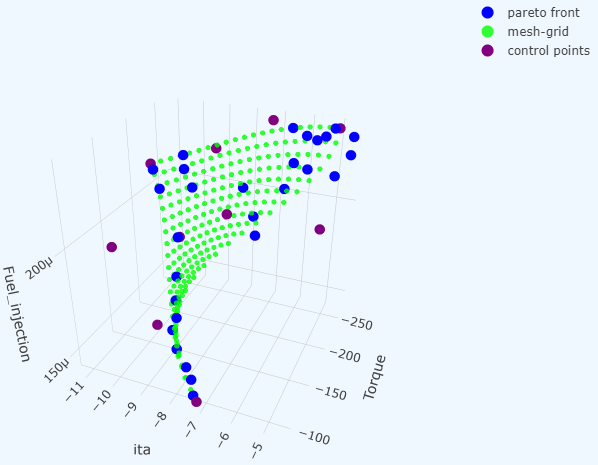
Assume we have a finite dataset \(B\subset\Delta^{M-1}\times\mathbb R^N\) and want to fit a Bezier simplex to the dataset. What we are trying can be formulated as a problem of finding the best vector of control points \(\mathbf p=(\mathbf p_{\mathbf d})_{\mathbf d\in\mathbb N_D^M}\) that minimizes the least square error between the Bezier simplex and the dataset:
PyTorch-BSF provides an algorithm for solving this optimization problem with the L-BFGS algorithm.
Why does Bézier simplex fitting matter?
In multi-objective optimization the Pareto front — the set of all trade-off-optimal solutions — is rarely a single point; it is a surface. For a broad class of problems (see weakly simplicial problems below), that surface is well-approximated by a Bézier simplex.
This has a powerful practical consequence: instead of solving the optimization problem exhaustively for every possible weight vector, you can solve it for a small number of carefully chosen weights, fit a Bézier simplex to those solutions, and then read off the entire Pareto front by evaluating the fitted surface. A canonical application is hyperparameter search for the elastic net, where the two regularization coefficients \(\lambda\) and \(\alpha\) span exactly such a simplex.
Approximation theorem
Any continuous map from a simplex to a Euclidean space can be approximated by a Bezier simplex. More precisely, the following theorem holds. See [1] for technical details.
Weakly simplicial problems
Such a map \(\Phi\) arises in, e.g., multiobjective optimization. There exists a continuous map from a simplex to the Pareto set and Pareto front such that the map sends a subsimplex to the Pareto set/front of a subproblem. See [3].
Application 1: Elastic net
The elastic net objective combines L1 and L2 regularization with two coefficients, \(\lambda\) (overall strength) and \(\alpha\) (L1/L2 balance). Together they define a point on a 2-simplex, making the elastic net a natural fit for Bézier simplex methods.
Rather than running a grid search over all \((\lambda, \alpha)\) combinations, you can solve the elastic net for a small set of simplex-structured weight vectors, fit a Bézier simplex to the resulting (solution, loss) pairs, and evaluate the surface densely at negligible cost. See [3] for the theoretical guarantees.
Strongly convex problems
All unconstrained strongly convex problems are weakly simplicial [3].
Weighted-sum scalarization and solution map
The weighted-sum scalarization \(x^*: \Delta^{M-1}\to\mathbb R^N\) defined by
We define the solution map \((x^*,f\circ x^*):\Delta^{M-1}\to G^*(f)\) by
The solution map is continuous and surjective. See [3] for technical details.
Application 2: Deep neural networks
Training a GAN involves balancing multiple competing losses. For consistency-regularized GANs (bCR / zCR), the generator and discriminator objectives combine several loss terms whose relative weights form a simplex structure. Fitting a Bézier simplex to solutions sampled across this simplex reveals the full trade-off surface without re-training from scratch for each configuration.
Concretely, the discriminator and generator losses are defined as
Statistical test for weakly simpliciality
When the problem class is not known in advance, it is not clear whether the Pareto set admits a simplex structure. A data-driven statistical test [4] can determine whether this assumption is warranted before committing to a Bézier simplex model. See [4] for the methodology and test statistics.
References
Kobayashi, K., Hamada, N., Sannai, A., Tanaka, A., Bannai, K., & Sugiyama, M. (2019). Bézier Simplex Fitting: Describing Pareto Fronts of Simplicial Problems with Small Samples in Multi-Objective Optimization. Proceedings of the AAAI Conference on Artificial Intelligence, 33(01), 2304-2313. https://doi.org/10.1609/aaai.v33i01.33012304
Tanaka, A., Sannai, A., Kobayashi, K., & Hamada, N. (2020). Asymptotic Risk of Bézier Simplex Fitting. Proceedings of the AAAI Conference on Artificial Intelligence, 34(03), 2416-2424. https://doi.org/10.1609/aaai.v34i03.5622
Mizota, Y., Hamada, N., & Ichiki, S. (2021). All unconstrained strongly convex problems are weakly simplicial. arXiv:2106.12704 [math.OC]. https://arxiv.org/abs/2106.12704
Hamada, N. & Goto, K. (2018). Data-Driven Analysis of Pareto Set Topology. Proceedings of the Genetic and Evolutionary Computation Conference, 657-664. https://doi.org/10.1145/3205455.3205613